An essay commissioned by artist Sarah Fortes Mayer as part of her solo exhibition In the blink of an eye at K4 Architects, November 2018.

As I look at a portrait, I look into the gaze of another. The gazer is fragmented in two: the part that belongs to themself and the part that belongs to the person who returns the gaze, namely their self. A reciprocal gaze confirms both. The gazers are split twice over.i A portrait contains and reflects back to the seer the echo of their gaze. The seer sees themselves being seen.ii
A gaze is a look that contains a ‘particular thirsty intensity.’iii
He is starting to look more intently now. He can fix his gaze on mine.
A ‘knot’ of entangled gazes operate in Bettina von Zwehl’s photographic portraits, within and outside the frame.iv von Zwehl stands invisibly outside the frame in Profiles III No. 3 (2005). The artist looks at the baby and the baby looks at her as she clicks the shutter. The baby’s mother, likewise invisibly outside the frame, looks at both baby and artist. The viewer is outside of the frame and looks at the baby but is pivotal in animating the multiplicity of gazes. The invisible gazes of mother and artist exist in a ‘field of other people’s looks.’v Just as we are the possessor of a gaze, we are also always the subject of a gaze, for there is no ‘one’ gaze at all.
He breaks from my breast and smiles up at me with his bright blue eyes.
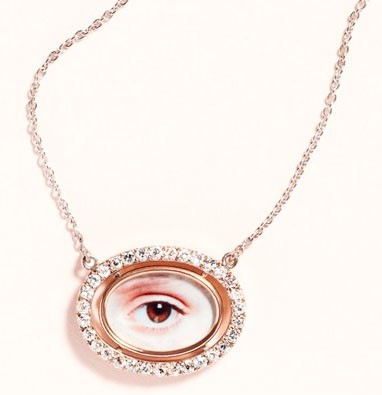
Zwehl, jewellery design by Laura Lee
Georgian painted eye miniatures or ‘lovers’ eyes’ were made as tokens to be exchanged: treasures to be gazed upon and caressed. They are love letters. They are precursors to the photographic gifts we give and occupy a specific art historical niche in the social contexts of image production and dissemination. Painted eye miniatures were created for a specific viewer – an individual ‘I’ – designed to be viewed in solitude and worn against the skin as jewellery. Such intimate image-objects function within the all-consuming circuit of the gaze. von Zwehl’s jewelled photographic eye miniature, Eye Portrait (Ruby) (2013), which uncovers the reciprocal mechanisms of the gaze, is taken from the tiny eye of her daughter. Ruby’s eye watches over you as you look into it, this time within the public sphere of display.vi
There are three tiny dots on the outside edge of his right iris, lined up in a row like a kind of notation, uniquely patterned.
A portrait affords a viewer permission to garner pleasure in looking: a protracted, sensuous form of looking that the viewer controls. A viewer claims ownership over the image of another, for it is theirs to look at.
A text desires a reader.vii So too, a portrait desires a viewer.
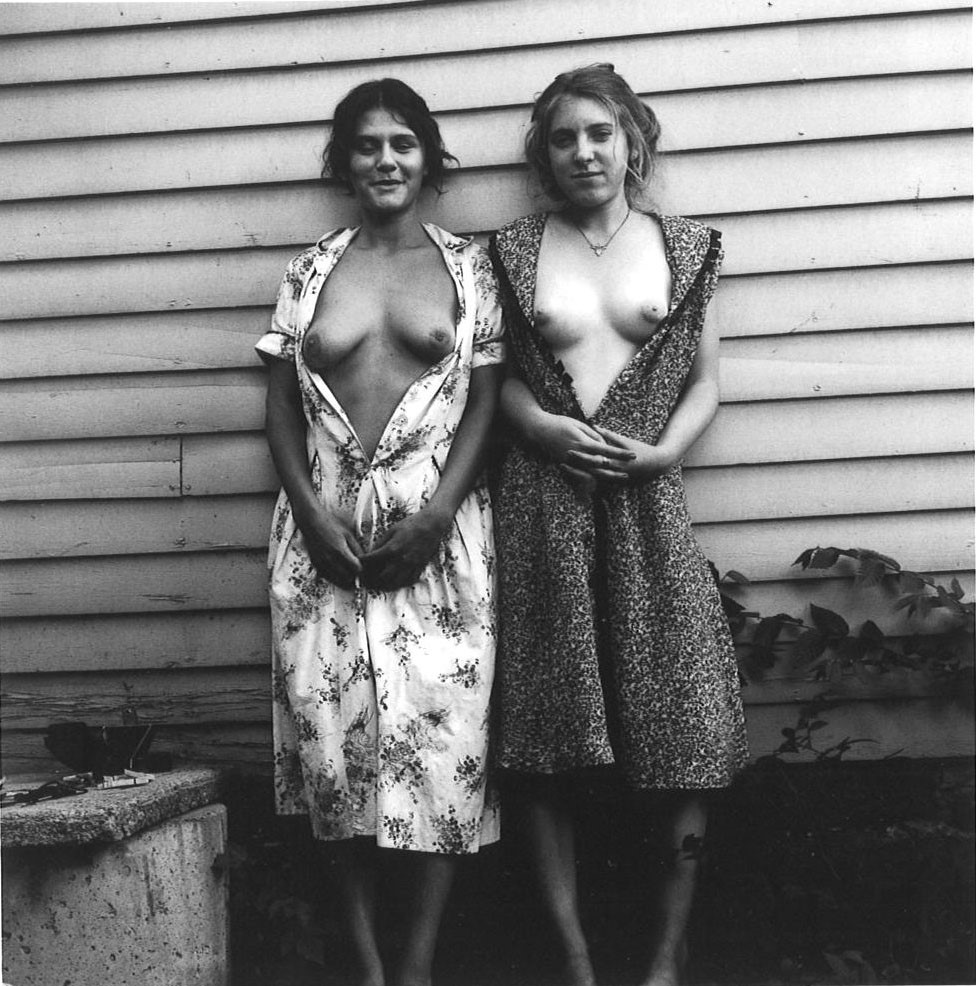
In Francesca Woodman’s photograph Untitled, Boulder Colorado (1972) Woodman and her friend are depicted with their dresses opened to reveal their breasts. Their nipples form ‘two more pairs of eyes for our eyes … [and gaze] out at me (for me).’viii At work in such images is a jouissance, a sensual ownership of the subjects’ bodies via the gaze of their eyes or other body parts. Claiming nipples as eyes in this photograph is not as strange an assertion as it might seem, for navels can see through the surface of a photograph just as effectively as eyes can. Each participates in the entangled knot of looks at work within a portrait and returns the gaze of the viewer.
He gazes at me intensely now. His eyes unwavering. His dad says its unconditional love.
i Roland Barthes, The Pleasure of the Text. New York: Hill and Wang, 1980, p. 14
ii James Elkins, The Object Stares Back, Orlando: Harvest, 1999, p. 70
iii ibid., p. 210
iv Darian Leader, ‘Primal Scene Photography’ in Photoworks, Bettina von Zwehl. Göttìngen: Steidl, 2007, p. 25
v ibid.
vi Bettina von Zwehl, A Lecture for the Volunteers of the Holburne Museum (artist talk online). Holburne House Museum, Bath, 20 May 2013. Available from: http://www.youtube.com/watch?v=VIeCOeiKNT
vii Barthes, The Pleasure of the Text, p. 6 and p. 27
viii Carol Mavor, Becoming: The Photographs of Clementina, Viscountess Hawarden. Duke University Press London, 1999, p. 165
Anneka French, September 2018
 Anneka French